Limb loss affects people at every age, and the prosthetic care that follows looks different depending on whether the patient is a toddler taking first steps, a teenager navigating high school, or an adult in the middle of a career. Age shapes not just the physical dimensions of care — the size of the device, the growth rate of the residual limb — but the psychological context, the family dynamics, the functional goals, and the kinds of questions that need to be answered before meaningful progress can happen.
The temptation in discussing prosthetics is to treat age as a single variable in what is otherwise a standardized process. In practice, pediatric and adult prosthetic care represent genuinely different clinical disciplines. The best outcomes — for children and adults alike — come from care teams that understand those differences, rather than applying a single clinical framework across the lifespan.
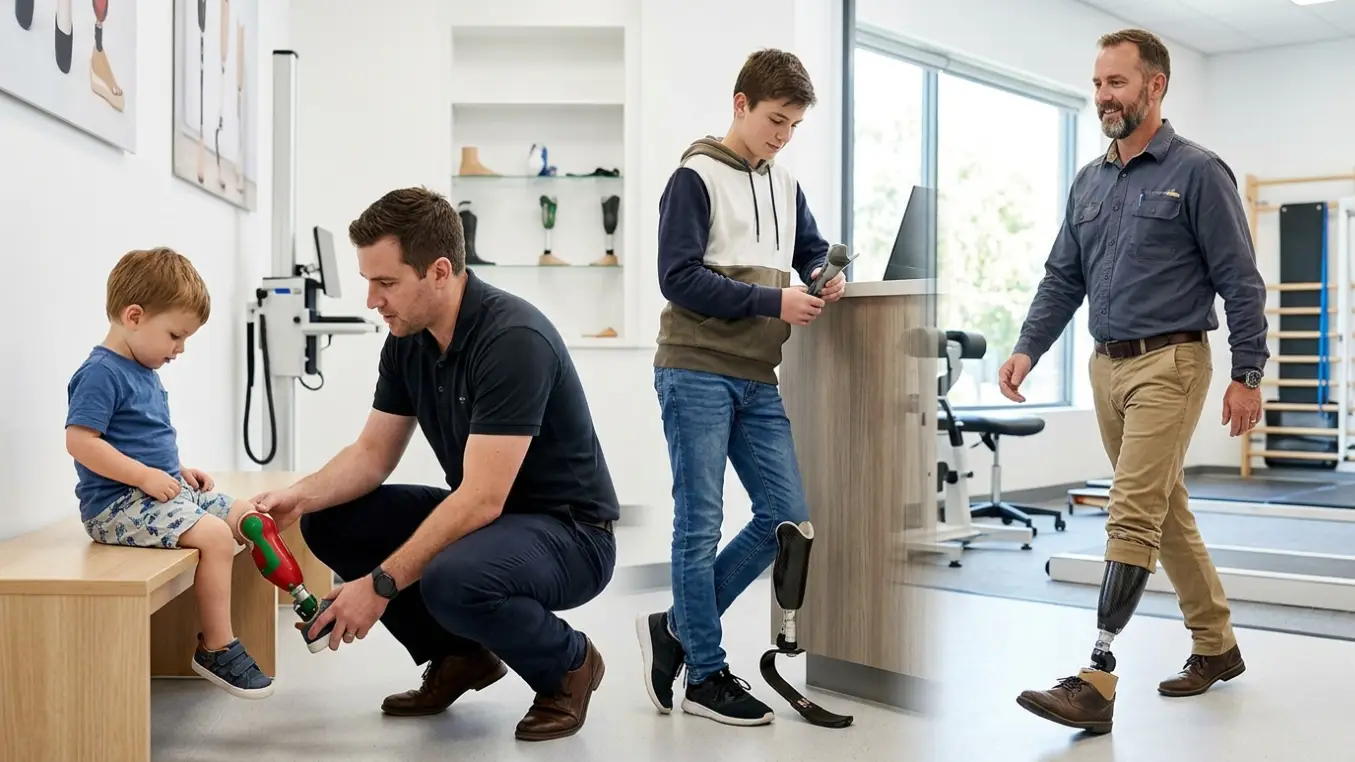
This piece looks at both populations: the considerations that define pediatric prosthetic care, the options available for adult upper and lower limb users, and the factors that consistently separate good outcomes from merely adequate ones.
Why Pediatric Prosthetic Care Is Its Own Field
Children are not small adults. That observation seems obvious, but its implications for prosthetic care are substantial. Pediatric residual limbs grow, which means sockets become ill-fitting on a developmental timeline rather than an activity-or-volume-change timeline. A child with a below-elbow limb difference may need socket replacements several times a year in periods of rapid growth — a maintenance cycle that has no parallel in adult prosthetics and that requires both clinical planning and insurance navigation that many generalist clinics aren’t equipped for.
For families navigating this for the first time, pediatric prosthetics programs staffed by clinicians with specific training in childhood limb loss are a different experience than adult-oriented clinics that occasionally treat younger patients. The developmental framing is different — goals are set in terms of motor milestones, play function, and school participation rather than occupational function and independent living — and the family is a central part of the clinical team in a way that isn’t typical in adult care.
The question of when to introduce a prosthetic for a child with congenital limb difference or early-life amputation is nuanced. For upper limb cases, the evidence suggests that introducing a simple passive prosthetic early — sometimes as young as three to six months — can help establish bilateral exploration patterns during the developmental window when those patterns are forming. The device doesn’t provide powered function at that stage; it provides the cognitive frame of two limbs working together, which shapes how the child develops reaching, grasping, and manipulation skills.
Upper Limb Prosthetics for Adults: Options Across the Spectrum
Adult upper limb amputation spans a wide range of causes, levels, and functional goals. Trauma is the leading cause in working-age adults; vascular disease and cancer account for significant proportions of cases as well. The prosthetic goals of a thirty-year-old manual worker who has experienced traumatic below-elbow amputation are different from those of a sixty-year-old who has had a transhumeral amputation following cancer surgery, and the clinical approach should reflect that.
Access to well-designed custom upper limb prosthetics is one of the most important factors in adult upper limb outcomes. Upper limb sockets are inherently custom — there is no meaningful off-the-shelf equivalent for complex upper limb levels — but the quality of that custom work varies considerably. The socket has to capture the residual limb precisely enough to provide stable suspension and effective control without restricting the proximal joints or creating pressure injuries over bony prominences. The difference between a well-fabricated socket and an adequate one is directly experienced in hours of daily use.
Terminal device selection — the choice between prosthetic hands, hooks, and activity-specific devices — has expanded significantly in recent years. Myoelectric hands with multiple programmable grip patterns are available for eligible transradial and transhumeral users. Activity-specific terminal devices for tools, sports, and work tasks address use contexts that prosthetic hands don’t serve well. Most upper limb users who achieve good long-term outcomes have multiple devices for different purposes, a toolkit approach that should be part of the initial clinical planning.
Lower Limb Prosthetics Below the Knee: What Adults Need to Know
Below-knee amputation is the most common level of lower limb loss in adults, driven primarily by diabetes and peripheral vascular disease in older populations and by trauma in younger ones. The prosthetic outcomes available at this level are among the best in the field, with many users achieving close-to-normal ambulatory function with appropriate fitting and rehabilitation.
The search for the best prosthetic leg below knee is less a question of brand or model than it is of matching components to the individual’s activity level, body weight, lifestyle, and terrain demands. A prosthetic foot rated for high activity levels provides unnecessary stiffness and reduced comfort for a sedentary or low-activity user. The reverse — a foot designed for low-activity users placed with an active person — leads to fatigue, inefficient gait, and risk of overuse injury in the proximal joints.
Liner technology has improved considerably over the past decade. Pin-lock, lanyard, and suction suspension systems each have specific advantages in different clinical situations, and the choice of liner and suspension method affects fit stability, skin tolerance, and ease of donning and doffing. These details matter in daily life, particularly for users who need to remove and reapply the device multiple times throughout the day.
The Role of Family in Pediatric Cases
For children with limb differences, the family is not a peripheral participant in the prosthetic process — it’s a central one. Parents and caregivers are responsible for putting on and taking off the device, monitoring skin integrity, managing the emotional dimensions of a child’s experience with their limb difference, and advocating for appropriate care and accommodations in school and social settings. They are, in effect, part-time members of the care team.
Good pediatric prosthetics programs recognize this and invest in family education as a core component of care. Teaching parents how to check skin integrity under the socket, how to recognize early signs of fit problems, how to communicate developmental progress to the clinical team, and how to navigate the school accommodation process is as important as the technical work of fabricating the device itself. Families who feel equipped and supported navigate the process significantly better than those who feel like observers.
School, Work, and Community Participation
The functional goals of prosthetic care are ultimately about participation — in school, in work, in the activities and relationships that give life its texture. For children, that means being able to engage in play, sports, art, and classroom activities with enough ease that the prosthetic becomes a tool rather than an obstacle. For adults, it means being able to work, maintain relationships, and pursue the hobbies and physical activities that mattered before amputation.
Neither goal is automatic. Both require prosthetic devices that fit well, clinical training that goes beyond basic function, and ongoing support as participation contexts change. The school environment poses specific challenges for pediatric prosthetic users — gym class, playground activity, art and music programs — that require device configurations and teacher awareness that don’t arise in standard clinical planning. Adults returning to work face different challenges depending on the physical demands of their occupation, and the prosthetic care team should be actively involved in workplace accommodation planning.
Finding the Right Provider for Your Situation
The choice of prosthetics provider is consequential at any age, but the criteria differ by population. For pediatric cases, the most important questions are about developmental experience — how many pediatric patients does the clinic see annually, does the team include a prosthetist with specific pediatric training, and how is the family integrated into the care process? For adult cases, the relevant questions center on experience with the specific amputation level, the range of control system options offered, the post-delivery adjustment process, and the integration of rehabilitation support.
In both populations, the quality of the ongoing clinical relationship — not just the initial fitting — is the variable that most reliably predicts long-term outcomes. Prosthetic care is a long game. The device will change as the person changes, and the care team that can adapt to those changes over years and decades is worth considerably more than one that fits well at the start and is difficult to access afterward.
Whether the patient is a two-year-old learning to reach or a fifty-year-old returning to work, the path forward looks similar in outline: a thorough evaluation, a well-fitted device built for the person’s actual life, skilled clinical training, and a care team committed to the long term. The details within that outline vary enormously. The quality of the people managing those details makes all the difference.