

A patient calls a clinic during the morning rush. The receptionist is checking someone in, another patient is waiting at the desk, and a second phone line starts ringing.
The caller waits.
Then the call goes to voicemail.
For healthcare organizations, moments like this happen every day. They are not necessarily the result of poor service. Often, clinic teams are simply managing more conversations than they can handle at once.
At the same time, patients increasingly expect healthcare organizations to be easy to reach. They want quick answers about appointments, office hours, services, availability, directions, and other routine questions.
This is creating a growing challenge for healthcare providers: how do you make communication more responsive without continuously adding administrative workload?
One technology emerging as part of the answer is the AI receptionist.
AI receptionists use conversational artificial intelligence to answer routine patient calls, collect information, respond to common questions, and support appointment-related workflows. Rather than replacing healthcare staff, their most practical role is handling repetitive communication so staff can focus their attention where human involvement matters most.
What Is an AI Receptionist in Healthcare?
An AI receptionist is a conversational system designed to manage some of the routine interactions that would traditionally be handled by a front-desk team.
Depending on how a system is configured, it may be able to:
- Answer incoming phone calls
- Respond to common questions
- Share clinic hours and service information
- Capture caller details
- Support appointment requests
- Route more complex inquiries to staff
- Follow up after missed calls
- Send appointment-related messages
The goal is not to turn every patient interaction into an automated one.
Instead, AI can act as an additional communication layer between patients and the clinic.
Platforms such as HiClinic’s AI receptionist and clinic growth platform are being developed around this approach, combining automated call handling with patient communication, missed-call recovery, booking workflows, and follow-up tools.
For busy practices, the value comes from being able to handle routine communication consistently while keeping the front desk available for patients who need personal assistance.
Why Patient Communication Has Become More Difficult
Healthcare communication has changed significantly.
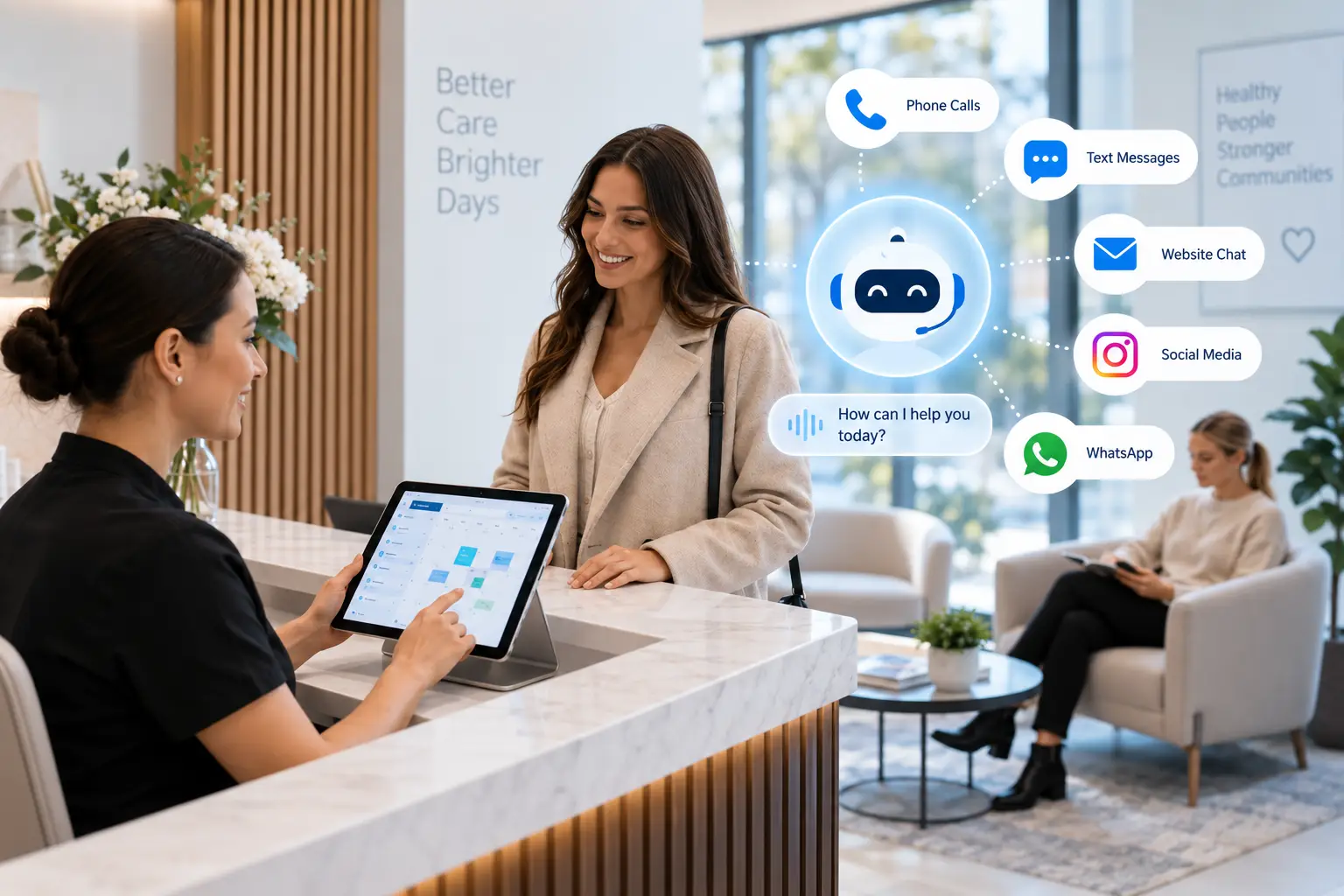
A clinic may now receive patient inquiries through:
- Phone calls
- Text messages
- Website forms
- Online booking systems
- Website chat
- Social media
Patients may also reach out before work, during lunch, after clinic hours, or while staff members are already helping other patients.
The front desk has therefore become much more than a reception function.
Staff members may be checking patients in, answering calls, managing schedules, confirming appointments, processing forms, responding to messages, handling cancellations, and coordinating follow-ups—all during the same shift.
Even highly organized teams have a limited amount of attention.
AI reception technology is gaining interest because it can take some of the predictable communication away from that workload.
1. AI Can Answer Routine Questions Immediately
Many incoming clinic calls involve similar questions:
“What time do you close?”
“Do you offer this service?”
“Are you accepting new patients?”
“Where are you located?”
“Can I book an appointment?”
These questions are important to the caller, but answering them repeatedly can take a significant amount of a receptionist’s day.
An AI receptionist can be configured with approved information about the clinic and use it to respond to common questions.
This gives patients faster access to basic information while allowing clinic employees to spend more time on tasks requiring judgment, empathy, or detailed knowledge of an individual situation.
It also reduces the need for callers to wait on hold simply to obtain information that may already be available in the clinic’s systems or website.
2. Clinics Can Respond Outside Regular Front-Desk Hours
Patient demand does not always follow clinic operating hours.
Someone may remember to book an appointment at 9 p.m. Another patient may call during their commute. A prospective patient may research several clinics over the weekend and contact whichever one appears easiest to reach.
Traditional voicemail records the inquiry, but it still requires staff to return the call later.
AI receptionists can provide another option.
Instead of simply asking the patient to leave a message, the system may be able to answer routine questions, collect information, or start an appointment request.
This does not mean every request should be resolved automatically. Complex medical questions, urgent concerns, unusual scheduling situations, and sensitive conversations still require appropriate human handling.
But many administrative interactions can at least be started immediately.
3. Missed Calls Can Become Follow-Up Opportunities
A missed call does not always result in a voicemail.
Patients may hang up and call another provider. Others may intend to try again and forget.
For clinics investing in websites, local search, advertising, referrals, and reputation building, unanswered calls can create a gap between generating patient interest and turning that interest into an appointment.
Automation can help close this gap.
For example, some clinic communication systems can trigger a text message after a missed call.
The message can acknowledge that the clinic was unable to answer and give the caller another way to continue the conversation.
That small workflow changes the patient experience from:
“No one answered.”
to:
“The clinic knows I called, and I have a next step.”
This is one of the more practical applications of AI and communication automation because it supports the existing team instead of forcing staff to monitor every phone interaction manually.
4. Appointment Requests Can Require Less Back-and-Forth
Scheduling may appear straightforward, but it often creates significant administrative work.
A typical booking conversation can involve several questions:
- Which service does the patient need?
- Is this a new or returning patient?
- Which practitioner should they see?
- What days work for them?
- What appointment times are available?
- Does the clinic need additional information before confirming?
When staff have to manage these conversations entirely by phone, even a basic appointment can require several interactions.
AI-assisted scheduling can help gather information earlier in the process and, where supported by the clinic’s systems and workflow, make booking more convenient.
The benefit is not merely speed.
A smoother booking process can also reduce interruptions for front-desk teams.
Instead of switching constantly between in-person patients and appointment calls, staff can focus on exceptions and more complicated scheduling needs.
5. Different Healthcare Specialties Can Use AI Differently
AI reception technology is not limited to one type of healthcare organization.
However, the workflow should reflect the specialty.
A physiotherapy clinic may receive frequent questions about appointment availability and services.
A counselling practice may want assistance capturing new client inquiries without creating an impersonal intake experience.
A wellness clinic may need to manage high volumes of booking questions.
Dental offices may have their own recurring communication patterns involving hygiene appointments, new-patient inquiries, consultations, cancellations, and scheduling.
For example, an AI receptionist for dental clinics can be configured around common dental workflows rather than relying on a generic answering system.
This industry-specific context matters.
Healthcare organizations should not adopt AI simply because the technology can answer a phone. The system needs to fit the way the clinic actually communicates with patients.
6. AI Can Help Create More Consistent Patient Communication
Consistency is another challenge for growing clinics.
A small team may know exactly how to answer common questions, but communication can become less predictable as the organization expands.
Different team members may provide information differently. New employees need training. Busy periods can cause callbacks to be delayed. Follow-up processes may depend on someone remembering to complete them.
Automation can provide structure around routine communication.
Clinics can establish approved responses and workflows for common situations, helping ensure that patients receive a more consistent experience.
This is particularly useful for administrative communication.
However, AI should not be treated as a replacement for clinical decision-making.
There is an important difference between answering:
“What time does the clinic open?”
and responding to:
“I am experiencing these symptoms. What should I do?”
Healthcare organizations implementing AI need clear boundaries around what the system can handle and when an interaction must be escalated.
7. Human Receptionists Still Have an Important Role
The rise of AI receptionists sometimes leads to a misleading question:
Will AI replace front-desk staff?
In many clinics, a more useful question is:
Which tasks actually require the attention of front-desk staff?
Healthcare administration includes many situations where human interaction remains essential.
Patients may be anxious, frustrated, confused, or dealing with sensitive circumstances. Scheduling exceptions may require judgment. Billing or insurance questions may be complicated. Some conversations simply benefit from speaking with a person.
AI works best when it handles predictable tasks and allows people to focus on unpredictable ones.
Instead of having an employee repeatedly answer the same question about operating hours, that employee may have more time to help a patient who requires extra attention.
The technology therefore has the potential to change the role of the front desk rather than simply remove it.
What Clinics Should Consider Before Adopting an AI Receptionist
Not every AI receptionist will be appropriate for every healthcare organization.
Before implementing one, clinic operators should consider several questions.
What conversations should be automated?
Start with predictable administrative tasks such as hours, directions, basic service questions, appointment inquiries, and missed-call follow-up.
When should calls be transferred to a person?
Clear escalation rules help prevent the system from trying to handle conversations outside its intended role.
How will the AI access clinic information?
Responses are only useful when information about services, hours, practitioners, and availability is accurate and regularly maintained.
Does it integrate with existing workflows?
Introducing another disconnected system can create more administrative work rather than less.
How are privacy and data handled?
Healthcare organizations should carefully evaluate how any technology provider collects, processes, stores, and protects patient information and determines whether the solution meets the requirements applicable to their clinic and jurisdiction.
The Future of the Healthcare Front Desk
AI is unlikely to eliminate the need for human communication in healthcare.
If anything, it may make human communication more valuable.
When routine administrative interactions can be handled automatically, clinic teams can spend more of their limited time on conversations that genuinely require empathy, judgment, and personal attention.
The future front desk may therefore operate less like a traditional phone-answering station and more like a coordinated communication hub.
AI can answer routine inquiries.
Automation can recover missed conversations.
Scheduling tools can simplify appointment requests.
Staff can manage exceptions and higher-value interactions.
The result is not necessarily a clinic without receptionists.
It is a clinic where technology handles more of the repetitive communication surrounding patient care.
Better Communication Starts With Removing Friction
Patients rarely think about the technology behind a clinic’s communication systems.
They simply notice whether getting help is easy or difficult.
Was their call answered?
Could they find the information they needed?
Was there an easy next step?
Could they request an appointment without repeated calls?
Did someone follow up?
AI receptionists are becoming increasingly relevant because they address these small but important moments.
Used thoughtfully, they can help healthcare organizations remain responsive while reducing some of the administrative pressure placed on clinic teams.
And as conversational AI continues to improve, the most successful implementations are likely to be those that do not attempt to remove people from healthcare communication—but instead use technology to ensure people are available when patients need them most.