Paint-by-numbers canvas with floral outline, brushes, and acrylic paint pots arranged neatly on a wooden surface
Most people accept that stress feels awful. Fewer realize it can physically wreck your digestion. If you’ve ever had a stomach ache before a big presentation, or noticed your gut acting up during a rough week, you’ve already experienced the gut-brain axis in action. The connection is real, bidirectional, and documented. What’s less obvious is that simple, low-pressure activities – the kind you can do from your sofa on a Tuesday evening – can interrupt this stress loop in ways that genuinely benefit your digestive health. This article explains why, starting with the biology.
The Gut-Brain Connection: Why Stress Shows Up in Your Stomach
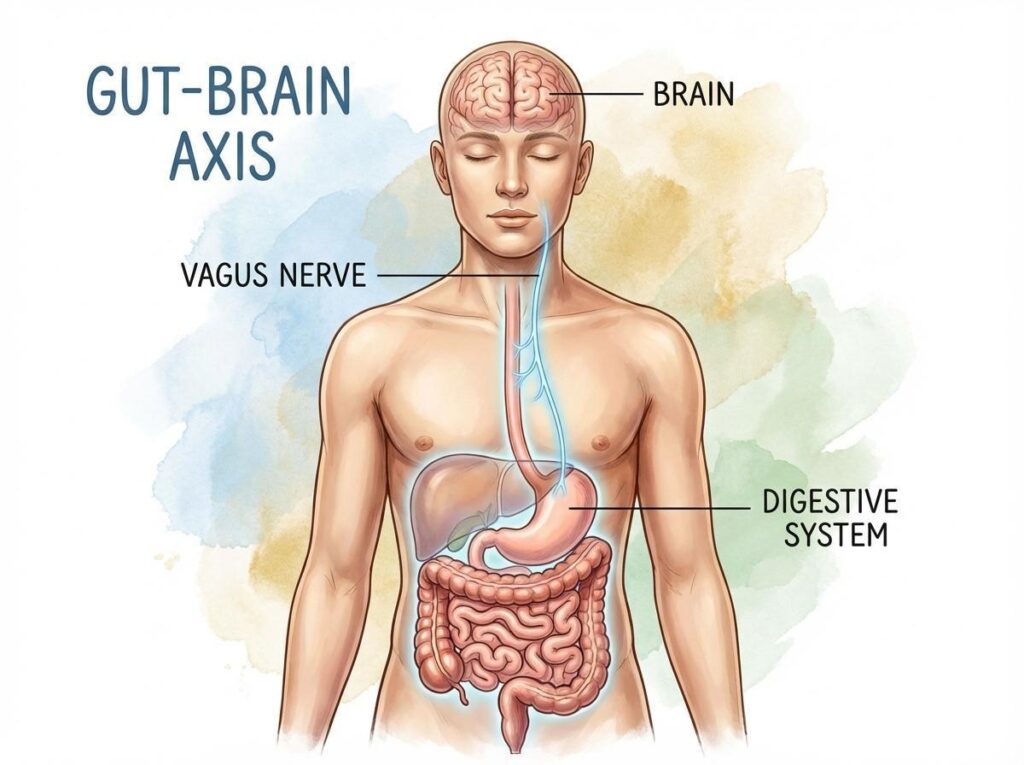
Illustration of the gut-brain axis showing the brain, vagus nerve, and digestive system in a human body diagram
Your gut and your brain are in constant conversation. The channel they use is the vagus nerve, a long winding nerve that runs from your brainstem down through your chest and into your abdomen. Signals travel both ways: your brain sends stress alerts down to your gut, and your gut sends distress signals back up to your brain. It’s a feedback loop, not a one-way street.
When your nervous system perceives a threat – a looming deadline, a difficult conversation, a sleepless night – it triggers a sympathetic “fight or flight” response. Blood flow shifts away from digestion. Gut motility speeds up or slows down erratically. Mucus production and intestinal permeability change. For people with irritable bowel syndrome, this cascade is particularly pronounced. IBS affects an estimated 11-15% of the global population, and stress is one of the most consistent symptom triggers identified in the clinical literature.
The good news is the reverse is also true. When your nervous system shifts into a parasympathetic “rest and digest” state, the gut benefits directly. Heart rate drops. The vagus nerve promotes motility. Digestion works as it’s supposed to.
That’s the key insight: your evenings matter. Not all wind-down activities are genuinely calming – and the difference shows up in your gut. This is exactly where relaxing art kits for home use come in – structured, low-pressure creative activities that give the nervous system a real off-ramp, without requiring any artistic skill or a big time commitment.
How Structured Creative Activities Calm the Nervous System
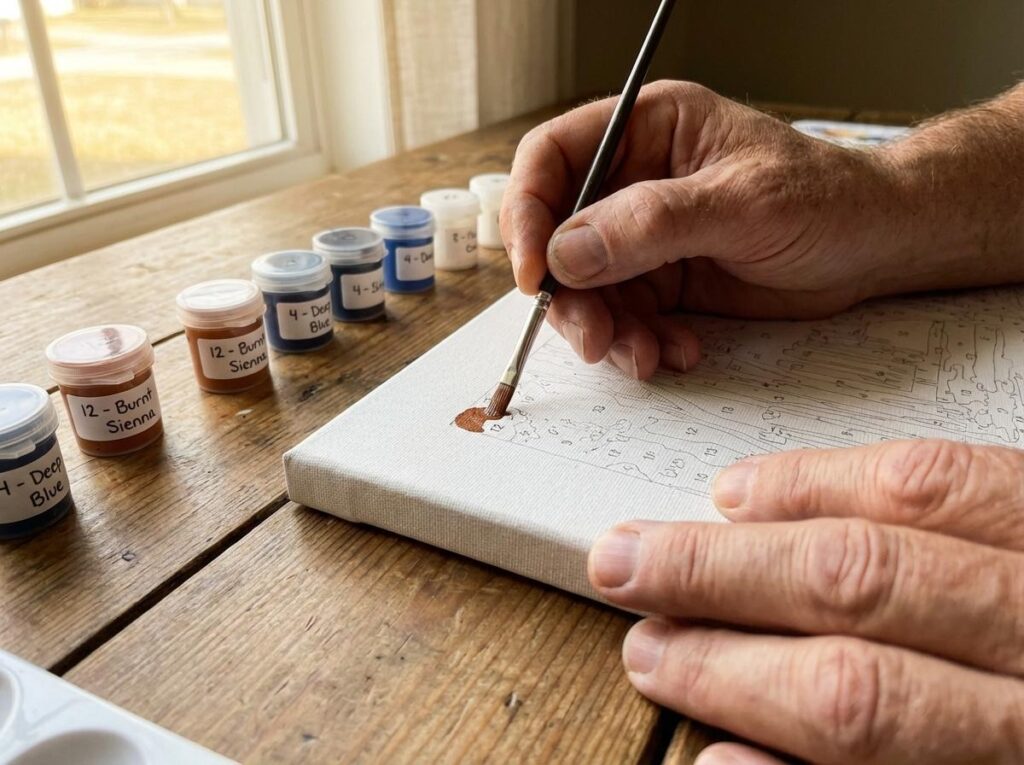
Hand painting a paint-by-numbers canvas with small labeled paint pots on a wooden table near a window
Not all downtime is equal. People often assume that anything that isn’t work is automatically restful. It isn’t. Scrolling through a news feed keeps your brain in a reactive, stimulus-hungry state. Watching high-tension TV keeps your cortisol elevated. These aren’t neutral activities – they’re mildly activating ones.
Structured creative tasks work differently. When you’re focused on a specific, contained visual task – filling in a numbered section with the right color, for instance – your brain enters something close to a flow state. Attention narrows. Rumination quiets. The default mode network, which is responsible for anxious, self-referential thought, takes a back seat.
Research from Drexel University supports this. A 2016 study by Kaimal, Ray and Muniz, published in the journal Art Therapy, found measurable cortisol reduction after art-making in 75% of participants after just 45 minutes – regardless of whether they had any prior artistic experience. The stress-relief effect held across all skill levels.
Passive screen time, by contrast, tends to keep the brain in reactive mode. If you’re managing stress-related gut symptoms, the type of evening activity you choose isn’t a trivial consideration. For a closer look at how digital habits affect your nervous system, this piece on managing screen time and digital habits covers the mechanisms in detail.
What the Research Actually Shows
The evidence base for creative activity and mental health has grown substantially in the past two years. It’s no longer a fringe wellness claim.
A 2025 meta-analysis by Huang and colleagues, published in the Journal of Psychiatric and Mental Health Nursing, reviewed 35 randomized controlled trials involving 3,167 participants. The findings on visual art therapy showed a significant reduction in anxiety symptoms, with a standardized mean difference of -1.31 (p < 0.001). That’s a large effect size. To put it in context, a value above 0.8 is typically considered clinically meaningful.
Separately, a 2025 study from King’s College London and Goldsmiths found that an 8-week digital art-making program produced statistically significant anxiety reduction among participants with high baseline anxiety (p = 0.0075). People who were most anxious going in got the most benefit.
A 2025 meta-analysis in Nature Mental Health, from Queen Mary University of London, went further. Reviewing arts interventions for older adults, researchers found that group and individual art activities reduced depression and anxiety at effect sizes rivaling pharmacological treatments. That’s a striking finding. It doesn’t mean art replaces medication for clinical conditions – it doesn’t. But it does confirm that the neural mechanisms involved are real and measurable.
The common thread across all three studies: you don’t need a therapist’s office, a prescription, or formal training. The calming mechanism works through sustained, focused creative attention. That’s accessible to almost anyone.
IBS, Anxiety, and the Case for a Calmer Evening Routine
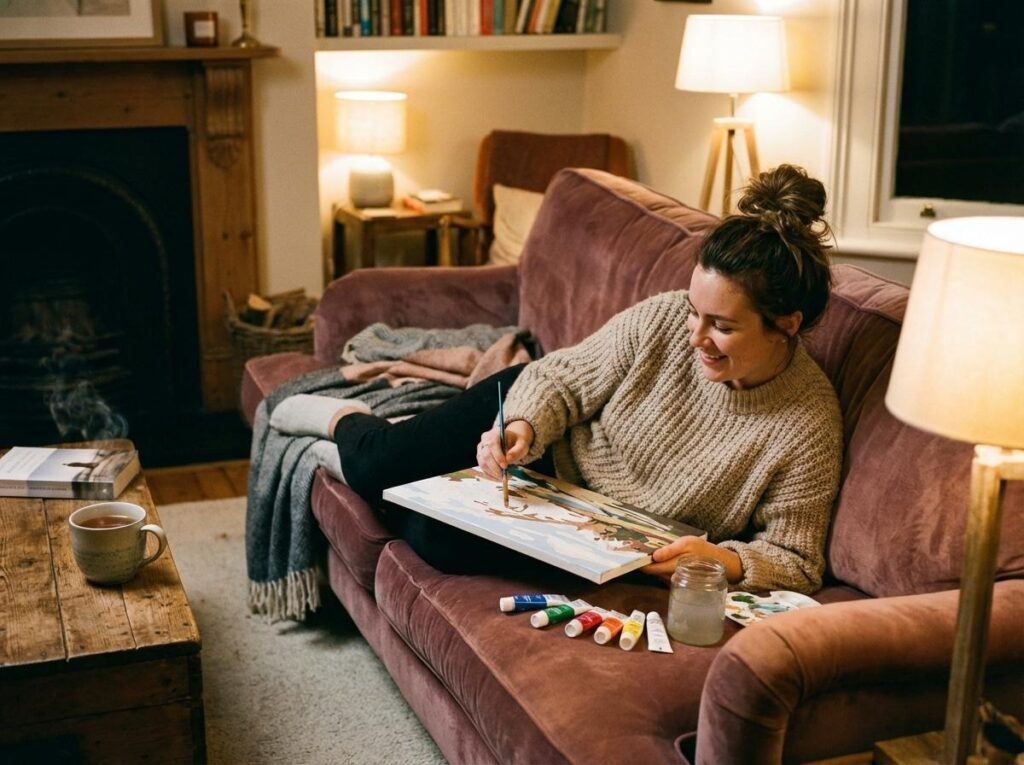
Woman painting on canvas at home while relaxing on a couch, with art supplies and paints nearby in a cozy living room
For people with IBS specifically, the case for adding a calming evening routine is especially strong. A 2020 study published on PubMed (n=68) found that 70% of IBS patients saw a significant reduction in symptoms after completing a mindfulness-based stress reduction program. Anxiety scores dropped alongside gut symptoms. The conclusion was direct: calming the nervous system reduces IBS flare frequency.
Harvard Health Publishing reinforces this from a clinical angle. Their overview on relaxation therapy and gut health confirms that relaxation responses – including low-stimulus, creative hobbies – can directly improve gut motility and reduce IBS symptom severity. This isn’t speculative. It’s the gut-brain axis working in your favor rather than against you.
Paint-by-numbers and similar structured creative activities produce the same neural state as mindfulness practices: focused attention, present-moment awareness, reduced rumination. You’re not thinking about tomorrow’s meeting. You’re thinking about whether that section should be blue or blue-green. That shift in attentional focus is what interrupts the stress-cortisol-gut cascade.
Consistency matters more than duration. Two evenings a week is enough to compound benefits over time. You don’t need to build an elaborate ritual.
Building a Simple At-Home Creative Routine That Actually Sticks
The biggest obstacle isn’t motivation – it’s friction. If getting started requires too many decisions or too much setup, the habit won’t last past the first week. Keep it simple from the start.
Start with 30 to 45 minutes, two evenings a week. That’s it. Don’t aim for daily practice at the outset. You want it to feel easy to maintain, not like another obligation.
Choose a structured format over freeform art. Blank canvas painting requires decision-making, which introduces cognitive load. Numbered, guided formats remove that pressure entirely. The creative process stays calming because all the compositional decisions have been made for you – you just focus on the act of painting.
Set up your environment deliberately. Low or warm lighting. Phone face-down or in another room. A warm drink nearby if that’s your thing. The goal is to signal to your nervous system that this is genuinely restful time – not half-attention time.
Track how you feel before and after, not the quality of the finished artwork. Notice your shoulders. Notice your breathing. The art is a vehicle, not the destination. If you feel calmer at the end than you did at the start, it’s working.
Treat this as a complement to medical care, not a replacement for it. Pair it with simple morning habits for digestive health that set a healthy baseline from the start of the day. For more on building wellness habits that hold up in a busy schedule, this piece on office-friendly wellness ideas is worth your time.
Your Gut Will Thank You
Stress really does show up in your stomach. The gut-brain axis isn’t a metaphor – it’s a physiological feedback system that responds directly to your nervous system’s state. When stress levels stay chronically elevated, your gut pays for it.
The encouraging part is that interrupting this cycle doesn’t require a dramatic lifestyle change. Consistent, low-pressure creative activity – the kind where you’re focused but not straining, engaged but not overstimulated – gives your nervous system the reset it needs. That reset shows up downstream in how your gut functions.
If you’ve been looking for something to add to your evenings that’s genuinely restorative, not just entertaining, a structured creative hobby is worth trying. Start small. Be consistent. Your gut is paying attention.