Most people assume a swallowing problem is just a temporary inconvenience. With achalasia, it is the exact opposite: every single meal becomes a daily struggle, and the condition rarely improves on its own. Achalasia is a rare esophageal motility disorder. According to medical data, only about two thousand people are diagnosed with it in the United States each year. That rarity is exactly why so many patients go years without receiving the correct diagnosis or adequate answers.
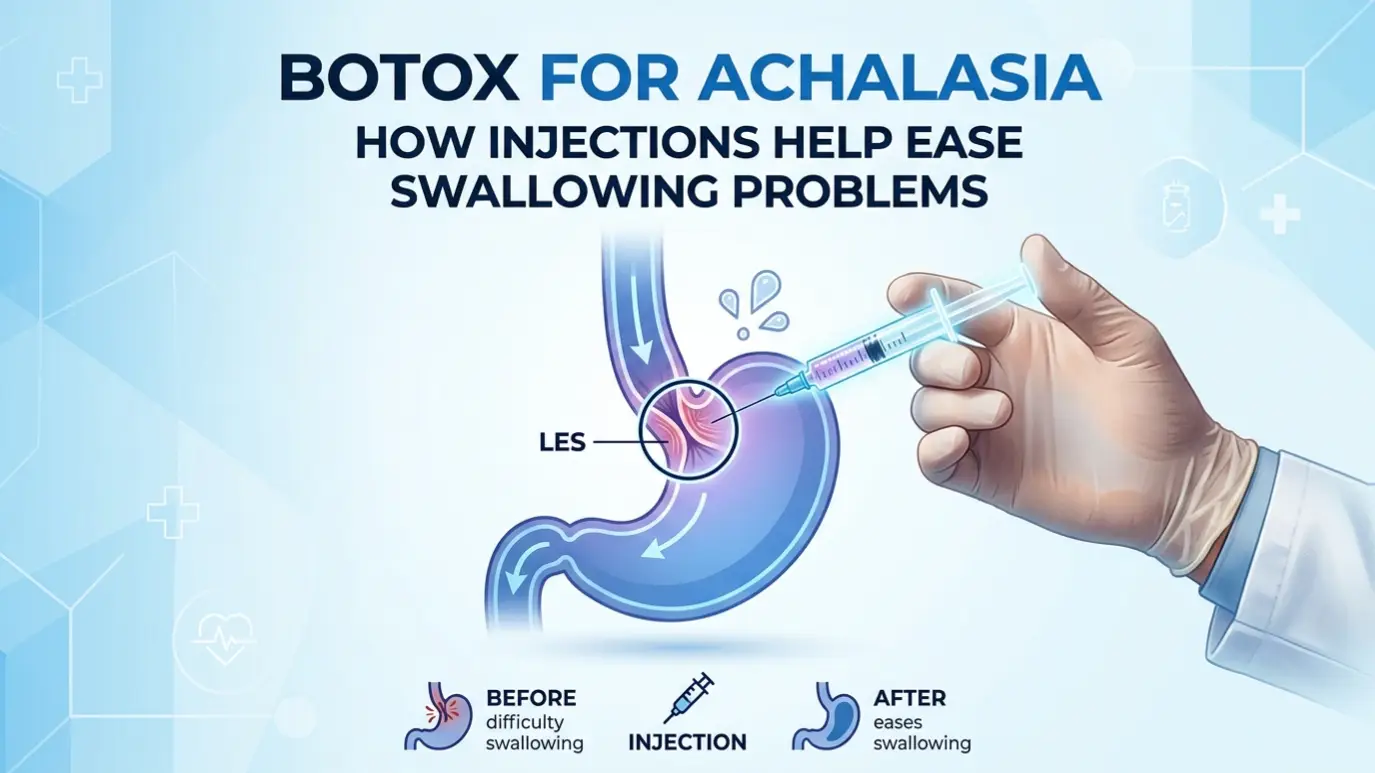
The encouraging news is that Botox for achalasia is a well-established, evidence-based treatment option that can deliver real, measurable relief without invasive surgery. Below, we will cover exactly how botulinum toxin injections work at the sphincter level, what the endoscopic procedure entails, who the ideal candidates are, and what you need to know before walking into your first gastroenterology appointment.
Key Points
- Achalasia affects approximately one in one hundred thousand people annually, causing the lower esophageal sphincter to fail to relax properly during swallowing.
- Botox injections work by blocking acetylcholine signals, allowing the excessively tight sphincter muscle to relax.
- The standard clinical protocol utilizes exactly one hundred units of botulinum toxin, delivered evenly into four quadrants of the lower esophageal sphincter.
- The minimally invasive endoscopic procedure takes roughly fifteen to thirty minutes, requires very minimal recovery time, and allows patients to return home the same day.
- According to clinical guidelines, Botox is the preferred first-line therapy for elderly patients or individuals who are not safe candidates for surgical intervention.
What is Achalasia and How Does Botox Help?
Achalasia strikes when the lower esophageal sphincter fails to relax properly, effectively blocking the path that food needs to travel from the esophagus down into the stomach. Botox injections provide relief by targeting the specific nerve pathways that force this muscle into a state of constant spasm.
The Mechanics of Achalasia
Achalasia begins with the progressive degradation of the nerve cells located in the esophagus that regulate muscle contractions. When those vital nerve signals break down, the lower esophageal sphincter becomes stuck in a tightly closed position. Because only a few thousand people receive this diagnosis annually, it remains one of the rarest esophageal conditions a specialist will treat.
Normally, acetylcholine signals instruct the sphincter to open and close appropriately as food descends. In an achalasia patient, that critical signaling fails entirely. Furthermore, esophageal peristalsis, which is the wave-like muscle contraction that pushes food downward, cannot generate enough force to overcome the blocked sphincter. In a variant known as vigorous achalasia, the esophagus contracts with intense force but still fails to move food into the stomach.
Dysphagia, defined as profound difficulty swallowing, is the defining symptom. Patients often experience the following complications:
- Severe chest pain or intense pressure during and after eating
- Regurgitation of undigested food, occasionally hours after a meal has ended
- Unintentional and sometimes dangerous weight loss due to food avoidance
- High aspiration risk, a dangerous event where trapped food or liquid overflows into the lungs
How Botulinum Toxin Restores SwallowingClostridium botulinum toxin naturally blocks the release of acetylcholine, making it highly effective for relaxing overactive muscles. Gastroenterologists perform an endoscopic botulinum toxin injection to deliver the medication precisely into the dysfunctional muscle tissue.
By relaxing the lower esophageal sphincter, the medication allows gravity to assist food in dropping into the stomach. Nitric oxide also plays a key role in natural sphincter relaxation, and reducing the excessive muscle tension via Botox allows the remaining natural mechanisms to work more efficiently. Patient records consistently show that most individuals notice meaningful changes in their swallowing capability within the first five days following the procedure.
Botulinum toxin provides a vital bridge to nutrition for patients suffering from achalasia. By rapidly relaxing the sphincter, we can restore a patient’s ability to eat comfortably and halt severe weight loss without subjecting them to the immediate risks of general surgery.
Comparing Achalasia Treatments
While Botox for achalasia is highly effective in the short term, it is important to understand how it compares to alternative therapies. Gastroenterologists typically evaluate patient age, overall health, and surgical risk when recommending a specific path.
| Treatment Type | Clinical Approach | Duration of Relief | Expected Recovery |
| Botox Injection | Temporarily paralyzes the sphincter muscle via endoscopic injection | Three to six months on average | Same-day discharge, very fast recovery |
| Pneumatic Dilation | A specialized balloon stretches and tears the sphincter muscle fibers open | Longer lasting, often several years | Short outpatient recovery |
| Laparoscopic Heller Myotomy | Surgical cutting of the exterior sphincter muscle through the abdomen | Long-term to permanent | Several weeks of restricted diet and healing |
| Peroral Endoscopic Myotomy (POEM) | Internal surgical cutting of the sphincter muscle using an endoscope | Long-term to permanent | Short hospital stay and dietary progression |
The Botox Injection Procedure for Achalasia
Understanding the procedural steps can significantly reduce patient anxiety. The Botox injection is delivered under direct visualization using a standard upper endoscopy, ensuring precise medication placement.
Preparation and Strict Fasting Guidelines
Proper preparation is a matter of absolute safety. Standard endoscopy fasting rules do not apply to achalasia patients because their esophagus actively retains undigested food. If food remains in the esophagus during sedation, it can enter the lungs and cause severe aspiration pneumonia.
To safely clear the esophagus, patients must adhere to strict guidelines:
It is important to note that, as a prescription medication, only medical professionals can order Botox vials online.
- Consume only a clear liquid diet for twenty-four to forty-eight hours prior to the procedure.
- Maintain an absolute fast, meaning nothing by mouth including water, for eight to twelve hours immediately before the appointment.
- Discontinue blood-thinning medications at least one week prior, under the guidance of the prescribing physician.
- Arrange for a responsible adult to provide transportation home, as driving post-sedation is prohibited.
What Happens During the Endoscopy?
The procedure is straightforward and minimally invasive. It does not involve any external incisions or permanent surgical cutting of the muscles. The process flows as follows:
- The patient receives intravenous sedation to remain comfortable and completely relaxed.
- The gastroenterologist gently guides a thin, flexible endoscope down the throat to clearly visualize the esophageal lining and the tight sphincter.
- A specialized sclerotherapy needle is passed through the endoscope.
- Exactly one hundred units of Botox are injected into four evenly spaced quadrants of the circular sphincter muscle.
- The endoscope is removed, and the patient is moved to recovery.
Clinical data indicates that the entire clinic visit averages under ninety minutes. The actual injection procedure takes less than thirty minutes to perform.
Recovery and Post-Procedure Care
Patients are monitored for roughly thirty to forty minutes as the sedation wears off. Most individuals report feeling completely normal by the time they are discharged. The most critical post-procedure rule is to reintroduce food slowly to avoid triggering spasms or temporary difficulty swallowing.
One of the most common mistakes patients make is attempting to eat a heavy, solid meal immediately after discharge. The esophagus needs time to adjust to the medication. Sticking to liquids and soft foods for the first twenty-four hours drastically reduces the risk of early post-procedure discomfort.
Benefits and Potential Risks of Botox for Achalasia
Weighing the clinical advantages against the potential side effects is an essential part of the medical decision-making process. Botox injections offer distinct benefits, particularly for specific patient demographics, but they are not a permanent cure.
Immediate Advantages of Botox
The most prominent benefit is the rapid speed of symptom relief combined with minimal physical trauma. There are no surgical incisions, no overnight hospital stays, and no extended periods of work absence. Furthermore, the procedure is entirely reversible and does not permanently alter the anatomy of the esophagus. This makes it an ideal choice for patients who cannot undergo general anesthesia or who are currently too frail for major surgery.
Known Side Effects and Long-Term Limitations
While generally incredibly safe, the injections carry temporary risks and long-term efficacy limits that must be understood.
| Risk or Side Effect | Clinical Description | Expected Frequency |
| Temporary Chest Pain | Mild to moderate aching in the center of the chest following the injection. | Common, usually resolves quickly. |
| Reflux and Heartburn | Stomach acid escaping upward due to the newly relaxed sphincter muscle. | Occurs in roughly ten to thirty percent of patients. |
| Decreased Efficacy | The immune system develops antibodies, making future injections less effective. | Moderate, frequently seen after the first year of repeated use. |
| Aspiration Risk | Liquid entering the lungs, usually caused by eating too quickly post-procedure. | Uncommon but requires immediate medical attention. |
FAQ
What is POEM, and how does it relate to achalasia treatment?
Peroral Endoscopic Myotomy is a more permanent surgical procedure performed through the mouth using an endoscope. Instead of injecting medication to relax the muscle, the physician physically cuts the excessively tight muscle fibers. It is highly effective but more invasive than Botox injections.
How quickly does Botox relieve achalasia symptoms?
Most patients begin to notice a significant improvement in their ability to swallow within three to five days after the procedure. The maximum relaxing effect of the medication typically peaks at about the two-week mark.
How long do the effects of the Botox injection last?
The symptom relief from a single Botox treatment usually lasts between three and six months. Because the nervous system eventually regenerates new pathways, the muscle will eventually tighten again, requiring a repeat injection.
Why do Botox injections stop working over time?
With repeated exposure to botulinum toxin, some patients develop a localized immune response. The body creates antibodies that neutralize the toxin before it can relax the muscle, leading to progressively shorter periods of relief after each subsequent injection.
Who is the best candidate for Botox over surgery?
According to major gastroenterological guidelines, Botox is heavily favored for elderly patients, pregnant women who require temporary symptom relief, or individuals with severe comorbidities that make surgical anesthesia too dangerous.
Reference List
- American College of Gastroenterology. ACG Clinical Guideline: Diagnosis and Management of Achalasia. https://gi.org
- American Society for Gastrointestinal Endoscopy. The Role of Endoscopy in the Evaluation and Management of Dysphagia. https://www.asge.org
- University of Chicago Medicine. Achalasia Diagnosis and Advanced Treatment Options. https://www.uchicagomedicine.org
- University of Michigan Health. Pre-Procedure Fasting Guidelines for Esophageal Motility Disorders. https://www.uofmhealth.org
- Centers for Medicare and Medicaid Services. Billing and Coverage Guidelines for Botulinum Toxin Injections. https://www.cms.gov