Imagine waking up, glancing at your wrist, and seeing a full overnight ECG and a readiness score predicting your training capacity. Ten years ago, that scenario belonged to medical dramas. Today, smarter monitoring technology is already nudging millions from reactive sick-care to proactive self-care.
In this deep dive, we’ll explore why wearable health technology is more than a consumer fad and how clinicians are weaving remote patient monitoring into everyday practice. All information here is educational only and is not a substitute for professional medical advice.
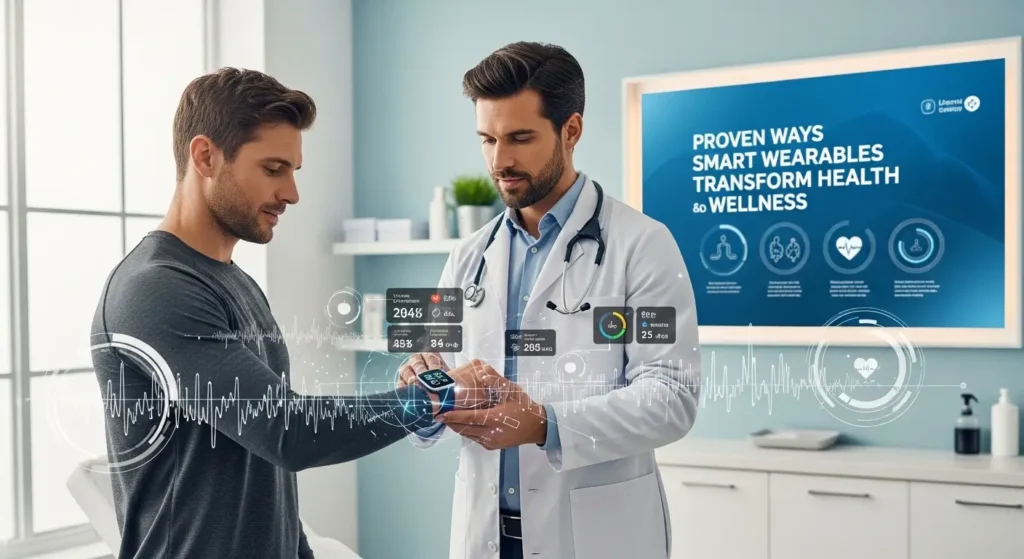
Benefits of Wearable Health Technology
Studies show that remote patient monitoring may slightly decrease the proportion of hospitalizations compared with usual care. Real-time access to metrics like heart-rate variability (HRV), oxygen saturation, and skin temperature lets both patients and clinicians spot anomalies before they spiral into emergencies.
Wearables also offer a powerful tool for managing long-term conditions with daily data. For diabetes, flash glucose sensors sync with apps to send alerts when blood sugar drops. Likewise, FDA-cleared optical blood-pressure wearables can now trend systolic values without cuffs, helping patients discover sodium triggers.
The true power of modern wearables lies in their predictive capabilities. Machine-learning models inside popular smart rings compare your rolling baseline to millions of anonymized data points. This allows them to generate early warnings for respiratory infections up to two days before symptoms appear.
Peer-reviewed studies show that daily wearable prompts boost medication adherence by 15–20%. This is a small but clinically meaningful margin when managing conditions like heart disease. It demonstrates how simple reminders can lead to significant health outcomes.
| Key Insight: The true revolution in wearable tech isn’t just tracking steps; it’s the fundamental shift from reactive sick-care to proactive, predictive self-care for millions. |
How Wearables Improve Your Health Day-to-Day
Beyond clinical applications, these devices integrate seamlessly into daily routines to foster healthier habits. According to research, 71% of Americans say the wearable technology has improved their health and fitness. From movement nudges to sleep coaching, the impact on daily life is significant.
Many devices use hourly vibration reminders to spur users to walk an extra 1,100 steps per day on average. For heart health, on-demand ECG smartwatches detect 90% of atrial-fibrillation episodes when worn consistently. These features provide easy ways to stay active and informed about your body’s signals.
Sleep-hygiene coaching is another key benefit, with smart rings tracking REM, deep, and light sleep cycles. Readiness scores can then adjust workout suggestions after a short-changed night. Additionally, gyroscope-based algorithms can auto-dial emergency contacts within 30 seconds of a hard impact, a lifesaver for older adults who live alone.
What to Consider Before Choosing or Using a Wearable
Before investing in a wearable device for health monitoring, it’s essential to evaluate several key factors. This ensures the technology you choose aligns with your health goals and integrates effectively with your care plan. Considering these elements will help you make an informed decision.
- Data Accuracy & Clinical Validation
Check for FDA 510(k) clearance or peer-reviewed validation studies. For SpO₂ measures, fingertip sensors remain the gold standard. For clinical technicians who need medical-grade oximetry, Cables and Sensors’ durable SpO2 monitor offers hospital-calibrated probes compatible with most bedside units. - Privacy & Security
Ensure the device and its companion app use end-to-end encryption. It’s crucial to confirm who owns the data—you, the device maker, or your insurer. - Cost & Reimbursements
Some remote patient monitoring (RPM) devices qualify for CPT codes, which can help offset costs. For example, the VHA remote patient monitoring program’s annual cost was $1,600 per patient, showcasing the financial models being built around this technology. - Battery Life & Comfort
A device in a drawer helps no one. Smart rings and discreet patches often win the comfort war over bulky watches, leading to better long-term adherence. - Clinician Integration
Look for devices that support FHIR, Apple Health, or direct EHR exports. Without a smooth data bridge, your physician may never see the valuable trend lines you’re collecting. - Long-Term Adoption
Motivation to use a new device typically dips after three months. Features like gamified streaks, social leaderboards, or pairing your daily habits with another positive activity can keep healthy habits engaging.
| Pro Tip: A device’s data is only useful if your doctor can access it. Prioritize wearables with simple clinician integration, like PDF exports, to bridge the gap between your wrist and your care team. |
Challenges in Continuous Monitoring
Despite their benefits, wearable devices come with challenges. Optical heart-rate sensors can struggle with darker skin tones, tattoos, and high-intensity arm workouts. These factors can sometimes trigger unnecessary atrial fibrillation alerts, causing undue anxiety.
Clinicians can also be overwhelmed when sifting through hundreds of data points per patient. AI-powered dashboards that intelligently prioritize only critical deviations are essential. This approach helps mitigate alert fatigue and make the data actionable.
There is a growing concern that wearable-derived risk scores could tempt insurers to hike premiums for individuals with certain health trends. Transparent algorithms and robust regulation are essential to protect consumers from potential discrimination.
Finally, the up-front device costs and associated subscription models may exclude low-income users from these powerful health tools. Loaner programs and value-based care incentives can help improve equity and access for all populations.
| Important: More data isn’t always better. Without smart filtering, clinicians face ‘alert fatigue,’ where critical health signals can be lost in a sea of non-actionable information. |
Features & Innovations to Watch
The field of wearable technology is advancing rapidly, with several groundbreaking features on the horizon. These innovations promise to make health monitoring even more seamless, accurate, and non-invasive. Here are a few key developments to watch.
- Cuff-less Blood-Pressure Wearables: Companies are pioneering optical sensors that provide 24/7 blood pressure trending rather than just snapshot readings.
- Non-Invasive Glucose Monitoring: Silicon-photonics-based wrist sensors are edging closer to FDA trials, representing a potential game-changer for managing type-2 diabetes without finger pricks.
- Advanced Fall & Crash Detection: Multi-sensor fusion in smartwatches can now differentiate between a real fall and simply dropping your device, improving accuracy and reliability.
- Post-Cardiac-Event Rehab Programs: Some healthcare systems now issue smartwatches to guide patients through low-intensity exercise, with the device vibrating if their heart rate exits a pre-determined safe zone.
- Multi-Sensor Smart Rings & Ear-Buds: Next-generation rings combine skin temperature, PPG, and EDA. New earbuds can measure core-body temperature via the ear canal, a metric previously reserved for ICU settings.
How Wearable Tech Is Reshaping Healthcare Systems
Hospital-at-home models are becoming more common thanks to wearable tech. Continuous vitals streamed to command centers allow for earlier discharge of stable patients. This frees up ICU beds and reduces costs significantly per patient episode.
In the U.S., CMS reimbursement for device data review incentivizes providers to adopt RPM programs. This aligns revenue with preventative care outcomes. It shifts the focus from treatment to proactive health management.
Aggregated, anonymized wearable data has already proven its public health value. For instance, Boston researchers were able to map influenza spread two weeks faster than traditional CDC reports by analyzing this data.
The integration of wearables with telehealth is creating faster care pathways. Smart-watch arrhythmia alerts can now trigger automatic tele-cardiology video calls. This has cut average response times for serious cardiac events in pilot programs.
| Key Insight: Beyond individual health, aggregated wearable data is a powerful public health tool, capable of mapping disease spread and health trends weeks faster than traditional reporting methods. |
Where Do We Go From Here?
Smarter monitoring technology has already proven its power to improve daily wellness, detect conditions earlier, and empower hospital-at-home care models. If you’re ready to step into proactive health, here are a few practical next steps:
- Bring your short list of devices to your next appointment and discuss which metrics actually matter for your specific health condition.
- Consider a two-week trial period with a new device to capture a baseline and see what patterns emerge from the data.
- Stay informed by subscribing to evidence-based newsletters that track FDA approvals and emerging research in wearable technology.
The future of healthcare is predictive, personalized, and already on your wrist. Use it wisely, collaborate with your care team, and keep the focus on data that drives healthier choices.