

Being in pain here and there is almost a normal part of being an adult. And if it’s the common kind of pain, like back pain or a headache, you don’t even pay attention to it.
You move on and act like nothing’s happening because you’re used to it by now.
Today, we’ll focus on back pain.
It can be pretty complicated sometimes because you may not know where it’s coming from.
And if you don’t know that, then how can you know what to do about it? Is it the normal kind of pain that you don’t need to bother yourself with, or is it the aftermath of an injury you had, but don’t remember anymore?
Let’s see how to tell the difference.
How the Pain Feels When It’s Caused by Daily Habits
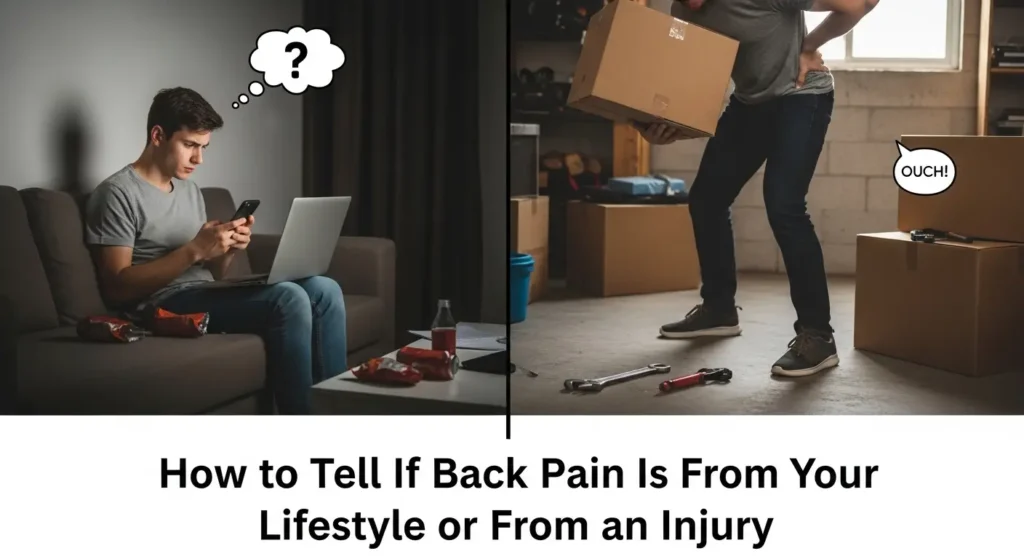
If the pain is caused just by the way you live your life, then you won’t be able to point to a moment and say, ‘Ahh, that’s where that’s from’.
It will sort of creep up on you, and the reasons for it are many.
Maybe you’ve been sitting for too long at a desk, or you have a bad habit of lying around on a saggy couch every evening. It will start as an annoying twinge and gradually become a constant ache that’s not so bad that it prevents you from functioning, but bad enough that you feel it all the time. Still, you’ll accept it as part of life and live with it.
The thing that makes this kind of pain different from the one that’s caused by injury is that it changes depending on what you’re doing.
Let’s look at a quick example:
You’ve been driving for hours on end, and you’ve been in pretty much the same position the entire time.
The pain here will feel tighter. And the moment you move around a bit – reactivate the muscles and redirect blood flow – the pain will ease up a bit. It’s dull and heavy. It’s sort of a heavy stiffness, not a sharp pain. It also gets triggered by some of the things you’d do on a daily basis (e.g., sleeping in certain positions or having poor posture).
The upside (if you can call it that) is that this pain is connected to your routine, which means that, if you make some changes to it, it will respond.
So when you feel the pain getting worse, it could be that you just change your posture a bit, and the pain gets easier or completely disappears.
In plain English, you have A LOT more control over this type of pain than you do over one that’s caused by an injury.
How the Pain Feels When It’s Caused by an Actual Injury
If you’ve been injured, then you know when and how it happened.
Maybe you were at an airport and when you picked up the suitcase, you felt a pull in your back because of how heavy the suitcase was, or you were playing sports and twisted something.
Basically, what’s happening is that there’s some sort of clear cause and effect.
But even though the ‘what’ might be clear, the ‘how’ remains murky.
This usually has to do with the fact that the exact moment (the ‘what’) of injury almost never feels dramatic… You know, like in the movies. You’d see someone with a massive back injury after falling down a flight of stairs. The sound effects are dramatic, the camera is dramatic, everything is dramatic. Then you see the person wriggling in pain, the ambulance is called – it’s an entire ordeal.
Real life is nowhere near as dramatic.
Take that slipping down a set of stairs. Let’s say it happened to you in a shopping mall.
The stairs were a bit slippery, and you just lost control. The next thing you knew, you were down at the floor level, and your back hurt. You’re almost certain you’ve suffered a back injury after falling here. But when you really open your eyes, you notice an entire crowd looking at you. Younger people took out their phones and started recording or even streaming. Naturally, what you feel at this moment is EMBARRASSED. This isn’t rational. You won’t call a lawyer here and 911, and witness statements – as you should – but you’d rather run away and go home to escape it all. By the time you get home, the pain has subsided, and you don’t even think about it because you’re busy doing chores.
But the next morning, once your muscles have cooled down, you can’t get out of bed. Panic sets in. Then you replay everything that happened yesterday. If the pain manifested even later, then you might not even connect it to the stair slipping from a couple of days earlier.
But what about the pain? What does the pain feel like?
IT definitely doesn’t feel the same as the pain you’d feel from sleeping in a weird position, or with the window open. Sure, it’s similar, but it’s MUCH sharper and more intense. More defined.
You can usually pinpoint the part of your back that hurts, and it doesn’t change, no matter how much you stretch. In fact, you’ll probably notice that the more you move, the worse the pain gets.
Another thing you’ll notice is that the pain is limiting you from doing some things, especially the ones you’ve always taken for granted, like twisting to look behind you or bending down to tie your shoes.
And if you feel the pain traveling down (e.g., into your leg or hip), that means there’s a nerve involved in the injury.
Conclusion
The most obvious way to tell the difference between these two kinds of pain is how you feel when you try to move.
If the pain comes from your lifestyle habits, you’ll most likely feel better, at least a little bit. If the pain is caused by injury, you’ll notice that it gets more intense the moment you try to do pretty much anything (let alone stretch or walk).
And once you figure out what’s causing the pain, you can finally do something to make it stop.


One Comment