

Learning how to perform a procedure is only one part of becoming a capable healthcare professional. Medical students and clinicians must also learn how to recognize a deteriorating patient, decide which problem requires immediate attention, communicate with colleagues, and adjust treatment when the patient’s condition changes.
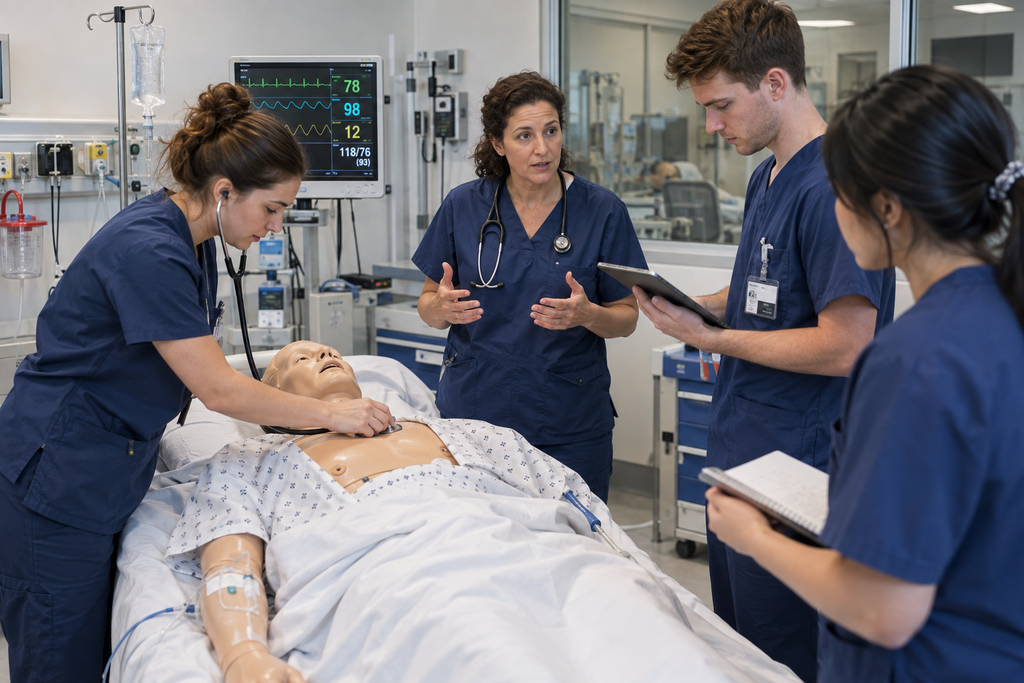
This is where full-body patient simulation adds another layer to medical education. While task trainers are highly useful for practicing individual procedures such as intubation, catheterization, injections, or suturing, advanced patient simulators allow learners to combine those technical skills with clinical decision-making.
Instead of practicing one isolated action, students can work through an entire patient encounter from assessment to treatment and reassessment.
From Practicing a Skill to Managing a Patient
Task trainers remain an important part of medical education because repetition helps learners develop procedural confidence. DrGinaSam.net has previously discussed how task trainers provide students with a controlled environment where clinical procedures can be repeated without placing real patients at risk.
Full-body simulation builds on that principle.
Consider airway management. A student can first use a dedicated trainer to learn how to position equipment and perform intubation correctly. A more advanced simulation can then place that same procedure inside a broader emergency.
The simulated patient may present with respiratory distress, changing oxygen saturation, abnormal breath sounds, altered vital signs, or a difficult airway. The learner must identify the problem, select an intervention, perform the procedure, and then decide whether the patient is improving.
This changes the educational question from “Can you perform the procedure?” to “Do you know when to perform it, how to respond if it does not work, and what to do next?”
That distinction is important because real clinical care rarely consists of isolated skills.
Why Real-Time Patient Responses Matter
High-fidelity simulation attempts to recreate the dynamic nature of clinical care.
An advanced full-body simulator may reproduce pulses, respiratory activity, cardiac rhythms, airway complications, neurological changes, bleeding, medication responses, and other physiological signs. Learners can assess the patient, make treatment decisions, and observe how the scenario changes in response.
The goal is not simply realism for its own sake.
A responsive scenario creates consequences for decisions.
If a healthcare team delays an intervention, the simulated patient’s condition can deteriorate. If the team identifies the problem and applies appropriate treatment, vital signs can improve. Instructors can also introduce complications that require learners to reconsider their initial diagnosis or treatment plan.
This gives students the opportunity to practice clinical reasoning while they are simultaneously performing physical tasks.
Organizations developing systems for this type of education increasingly combine physical manikins with software that records learner actions. For example, an adult patient simulator can support training involving ventilation, intubation, chest compressions, auscultation, cardiac monitoring, defibrillation, and medication administration while allowing instructors to review learner actions afterward.
That review may be just as important as the simulation itself.
Debriefing Turns Experience Into Learning
Running a realistic emergency scenario is not enough on its own. Learners need an opportunity to understand what happened.
Debriefing allows instructors and participants to examine decisions made during the scenario. They can identify where communication failed, why an important clinical sign was missed, or whether another intervention might have been more appropriate.
The Agency for Healthcare Research and Quality has emphasized both simulation and debriefing as tools for patient-safety education. Simulation provides a controlled setting where teams can practice without directly harming patients, while structured reflection helps participants learn from what occurred.
This is especially useful for situations in which several healthcare professionals must work together.
A cardiac arrest, trauma case, respiratory emergency, or rapidly deteriorating patient rarely involves only one clinician. Nurses, physicians, respiratory therapists, and other professionals may need to coordinate their actions within minutes.
Simulation gives teams an opportunity to practice not only medical procedures but also leadership, role assignment, information sharing, and closed-loop communication.
An instructor observing the scenario may discover that every participant understands the clinical problem individually, yet the team struggles to communicate effectively. That is difficult to identify from a written exam.
What Research Says About Simulation-Based Training
Research generally supports simulation as a valuable educational method, although the results need to be interpreted carefully.
A review of simulation-based medical education published in recent years has described improvements in areas such as skill acquisition, clinical competence, and opportunities for repeated practice. Other studies have found that simulation can improve performance when used alongside conventional education.
More recent research has also examined how simulation should be structured.
A 2026 systematic review and meta-analysis of competency-based procedural simulation found stronger skill outcomes for competency-based simulation compared with noncompetency-based approaches. However, the effects on behaviors in clinical practice and patient outcomes were smaller, and the authors identified continuing gaps in the available research.
That distinction matters.
It is reasonable to say that simulation can improve learning and procedural performance. It is more difficult to claim that every simulation program automatically produces better patient outcomes.
How the training is designed, how frequently learners practice, the quality of instructor feedback, and how closely scenarios match real clinical responsibilities can all influence the result.
Simulation Can Reveal Problems Beyond Individual Skills
Patient simulators are also useful outside traditional classroom education.
Hospitals can use simulation to test how teams respond in actual clinical spaces. Running a simulated emergency inside an emergency department, operating room, intensive care unit, or newly designed facility may uncover problems that would otherwise remain hidden.
Equipment may be stored in an inconvenient location. Staff may misunderstand who is responsible for a particular task. Important information may not move quickly enough between departments.
AHRQ describes these types of problems as latent safety threats and notes that simulation can help organizations identify and address them before they contribute to real-world harm.
This makes simulation useful not only for teaching individuals but also for evaluating healthcare systems.
The same principle applies to new protocols. Instead of introducing a workflow and discovering problems during patient care, a hospital can simulate the process first, observe how staff members use it, make changes, and then test it again.
Finding the Right Balance in Medical Education
Advanced patient simulation should not replace real clinical experience.
Healthcare professionals still need to interact with actual patients, understand individual preferences, communicate with families, respond to unexpected behavior, and experience the complexity of real healthcare environments.
Simulation serves a different purpose.
It allows learners to encounter certain challenges before those challenges carry real consequences. Rare emergencies can be repeated. Difficult procedures can be practiced. Teams can make mistakes and then examine them. Instructors can create standardized scenarios so that multiple learners face comparable challenges.
Task trainers and full-body simulators therefore do not need to compete for a place in medical education.
They address different parts of the learning process.
A task trainer may help a student master the mechanics of a procedure. A high-fidelity patient scenario can then ask the student to decide when that procedure is necessary, perform it while managing other clinical priorities, communicate with the team, and determine whether the intervention worked.
That progression reflects an important goal of medical education: moving from knowing how to perform individual tasks toward knowing how to manage the patient as a whole.
As simulation technology continues to develop, the most valuable systems will not necessarily be those with the greatest number of technological features. Their value will depend on how effectively educators use them to create meaningful practice, provide useful feedback, and connect simulated experiences with the realities of patient care.


