The human digestive system represents one of the most complex in the human body, yet for many patients, it remains largely unknown territory. Traditional understanding of gastrointestinal anatomy and function has historically relied on two-dimensional diagrams and technical explanations that often leave patients more confused than enlightened. However, we are currently witnessing a revolutionary transformation in patient education thanks to the implementation of 3D visualization digestive system technologies. These advanced tools are not only reshaping the way medical professionals teach but also enhancing digestive health understanding among patients worldwide.

The Limitations of Traditional Digestive Health Education
For decades, healthcare providers have struggled to effectively communicate the complexities of digestive health using conventional methods. Static images in textbooks and two-dimensional diagrams fail to capture the dynamic, interconnected nature of the gastrointestinal system. This educational gap becomes particularly problematic when patients need to understand complex conditions or surgical procedures.
The challenge extends beyond mere comprehension – when patients cannot visualize what’s happening inside their bodies, they often experience increased anxiety and decreased adherence to treatment plans. This is where traditional methods show their greatest limitation: they provide information without creating genuine understanding. The transition from abstract medical concepts to practical digestive health understanding requires more innovative approaches that can bridge this educational gap effectively.
How 3D visualization transforms digestive health comprehension
Bringing anatomy to life
The power of the 3D visualization digestive system lies in its ability to transform abstract concepts into interactive experiences. Through sophisticated interactive models of the digestive system, patients can now explore the entire gastrointestinal tract. They can virtually “fly through” the esophagus, stomach, and intestines, observing how each organ connects and functions within the larger system.
This immersive approach allows patients to grasp how the digestive system works at a fundamental level. Instead of trying to mentally piece together multiple two-dimensional diagrams, patients can manipulate three-dimensional models, zooming in on specific areas of interest and observing physiological processes in action. This hands-on exploration creates neural connections and understanding that simply cannot be achieved through passive learning methods.
Enhancing understanding of digestive disorders
Perhaps the most significant impact of 3D visualization appears in the field of digestive disorder visualization. Conditions that were previously difficult to explain, such as gastroesophageal reflux disease (GERD), inflammatory bowel disease, or diverticulitis, become clear and comprehensible when patients can see exactly what’s happening inside their bodies.
For instance, a patient with GERD can watch a dynamic simulation showing how stomach acid flows back into the esophagus due to a malfunctioning lower esophageal sphincter. Similarly, someone with Crohn’s disease can visualize the characteristic patchy inflammation throughout their intestinal tract. This visual context transforms abstract medical terminology into concrete understanding, significantly improving patient knowledge GI conditions and their management.
Practical applications in clinical gastroenterology
Revolutionizing patient education
The implementation of digestive system videos and interactive models in clinical practice represents a quantum leap in patient education gastroenterology. Gastroenterologists and healthcare providers now have powerful tools to explain complex procedures, conditions, and treatment options in ways that patients can easily understand and remember. Educational content created with an AI video generator can further enhance these efforts by transforming complex digestive health concepts into clear, visual explanations that are easier for patients to follow.
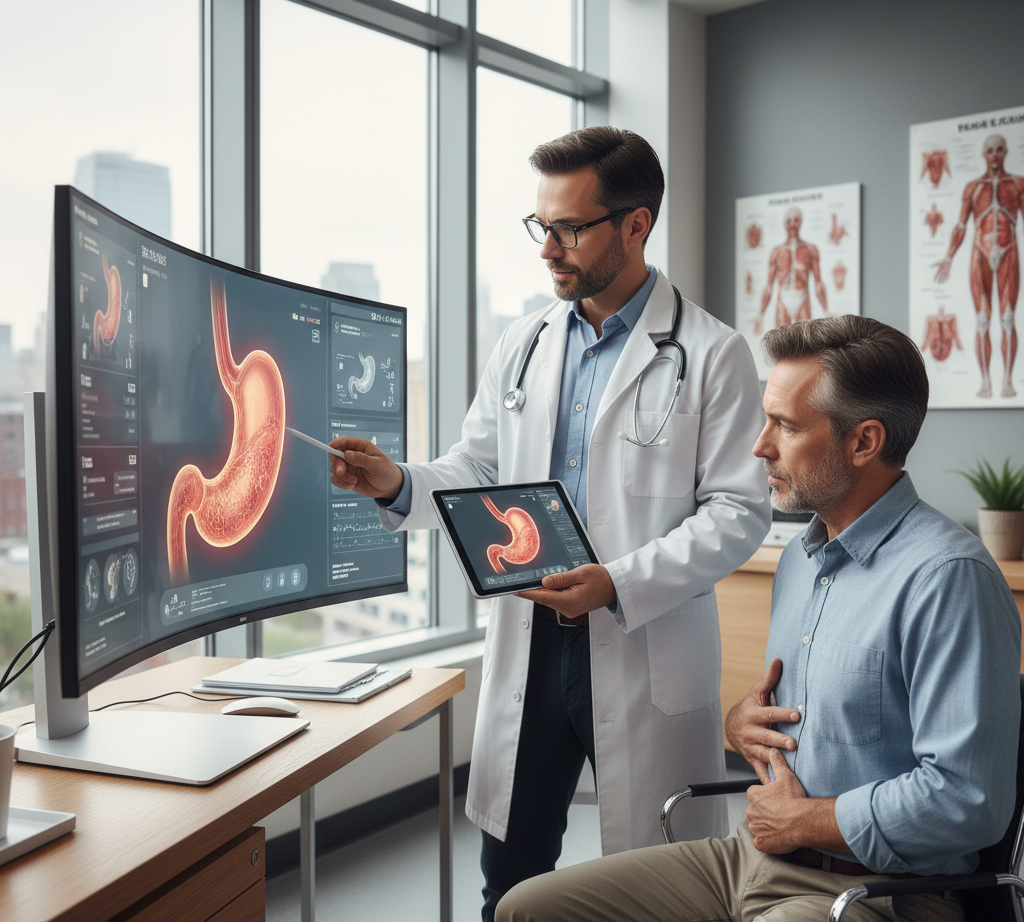
During consultations, physicians can use these models to demonstrate everything from routine colonoscopy procedures to complex surgical interventions. Patients can see exactly what a polyp looks like, understand why it needs to be removed, and comprehend how the procedure will be performed. This visual demystification of medical processes reduces patient anxiety and builds trust between patients and their healthcare providers.
Supporting treatment adherence and outcomes
The educational impact of 3D visualization extends directly to treatment outcomes. When patients truly understand their condition and the rationale behind their treatment plan, they’re much more likely to adhere to medical recommendations. This enhanced digestive health understanding translates into better medication compliance, lifestyle modifications, and follow-up care.
For example, a patient who can visualize how their dietary choices affect their irritable bowel syndrome symptoms is more motivated to maintain recommended dietary changes. Similarly, someone who understands the anatomical reasons for their acid reflux is more likely to consistently take prescribed medications and implement suggested lifestyle modifications.
The Future of Digestive Health Education
Integrating technology with clinical care
The integration of 3D visualization into routine gastroenterology practice promises to become even more seamless and impactful. We’re moving toward systems where patients can access personalized 3D models of their own anatomy, based on their actual medical imaging results. This personalized approach will take digestive health understanding to unprecedented levels. Clinics and medical institutions looking to acquire licenses for high-quality 3D renders and animations in gastroenterology for use in their practice can visit Shop.voka.io.
The future also holds promise for augmented reality applications, where patients could use their smartphones or tablets to project 3D models of the digestive system into their physical environment. This would allow for even more immersive and personalized educational experiences, further improving patient knowledge GI health and treatment understanding.
Expanding access to quality education
One of the most exciting developments in 3D visualization technology is its potential to democratize quality digestive health education. Through online platforms and mobile applications, patients worldwide can access sophisticated educational resources that were previously available only in major medical centers. This expanded access has profound implications for global digestive health literacy and preventive care.
Conclusion
The integration of 3D visualization digestive system technology represents a fundamental shift in how we approach digestive health education and patient education gastroenterology. By transforming abstract medical concepts into clear, interactive visual experiences, these tools are dramatically improving patient knowledge GI conditions and treatment options. The enhanced digestive health understanding achieved through these methods leads to better patient engagement, improved treatment adherence, and ultimately, superior health outcomes.
The journey toward comprehensive digestive health understanding is evolving rapidly, and 3D visualization stands at the forefront of this educational revolution. By embracing these technologies, healthcare providers can ensure their patients are not just informed, but truly comprehend their digestive health in ways that were previously unimaginable.