

Social media use can be constructive for fostering relationships and communication, but its use when done poorly can also play a role in disrupting sleep, increasing anxiety and depression, promoting social comparisons, and other mental health disorders. For PCPs, using the right questions to understand their patients’ social media usage can help address any possible issues.
Why Social Media Deserves Clinical Attention
Social media use has become an ordinary part of daily activities especially for children, adolescents, and young people. It employs mechanisms like personalized content, notifications, autoplay, and endless feeds which might prompt prolonged activity.
It is not that social media inherently induces mental disorders; some types of usage may interact with vulnerabilities in individuals together with other aspects influencing their health. In this way, being on social media until midnight will disrupt sleep, and continuous exposure to perfection or hostile communication will increase anxiety or low self-respect.
Therefore, digital activity is another aspect to be discussed together with other lifestyle and psychological factors.
What the New Mexico Meta Case Shows
A series of legal actions has once again shed light on the connection between social media and the well-being of youth. In August 2026, the New Mexico State Court ruled that Meta will have to make a payment of $567 million to be put into a youth mental health fund and make adjustments to how their platforms work for younger users. This follows a ruling by a jury in March, according to which the corporation will face civil penalties worth $375 million. Meta stated that it would appeal the decision.
This case is particularly important because the court found allegations related to the platform’s design and influence on younger users true. Notably, the court’s decision did not prove that the use of social media causes mental disorders, nor does it prove that everyone using social media experiences any psychological problems. Nonetheless, this case adds another instance of scrutiny of the effect of the digital environment on users.
Healthcare professionals need to keep in mind that while social media can be considered as one of the factors influencing the well-being of users, it is not a disease per se.
What Primary Care Providers Can Screen For
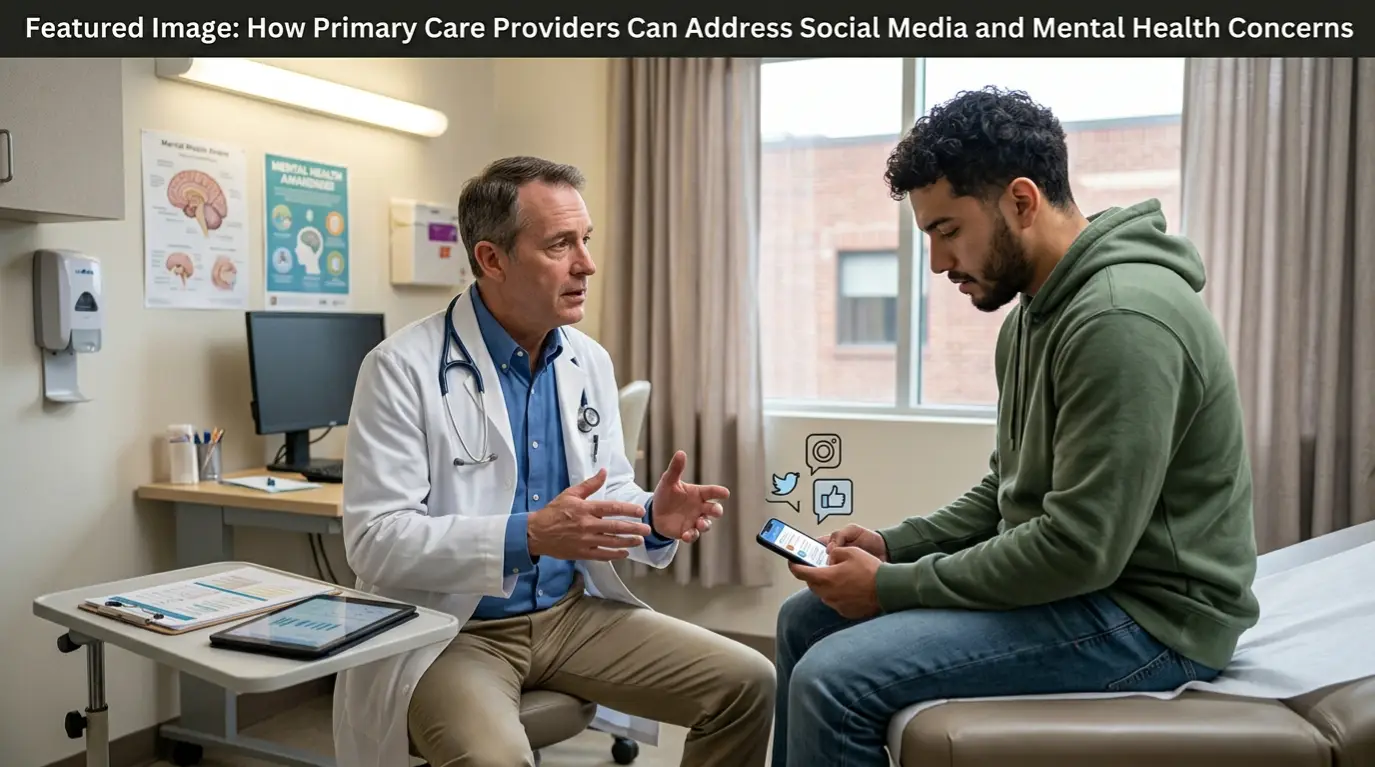
Primary care clinics are usually the first point of contact for any issues with sleeping, moods, stress, concentration, or behavioral problems. This makes a few simple questions about social media use an additional component to the standard evaluation process.
Some of the aspects to consider include the following:
- The frequency of social media use.
- If social media interferes with the ability to sleep.
- Whether the individual has trouble controlling his or her social media usage.
- If social media makes the person feel anxious, sad, or irritable.
- The role of social comparison in terms of impacting self-esteem.
- Issues related to cyberbullying or disturbing content.
- The effect on education, work, social life, and other activities.
It is important to keep in mind that the amount of time spent online by itself cannot prove that someone suffers from a mental health disorder. The level of functional impairment and emotions usually matter more.
Look Beyond Screen Time
A good evaluation will look at the impact of social media on the individual rather than only evaluating the number of hours spent each day.
For instance, one teen might be spending many hours interacting through social media and participating in school groups and have few problems as a result, whereas another individual spends few hours and is distressed due to cyberbullying, social comparison, or being exposed to offensive material.
Therefore, clinicians could assess if there are any changes related to sleep, studies, work, relationships, mood, or everyday activities.
Also, social media may affect already existing issues. One could become obsessed with responses on the internet if they suffer from anxiety, and the same person suffering from depression could become more isolated while spending hours browsing negative materials online.
When a Psychiatric Referral May Be Appropriate
Screening is not valuable if patients do not have adequate follow-up services available. If a symptom is noted by the primary care physician, a referral for psychiatric consultation would be of great help.
This is all the more true if the symptoms become worse or begin to interfere with the patient’s everyday activities. When a person exhibits any serious symptoms such as suicidal ideation, severe depression, psychosis, or any other acute psychiatric condition, it becomes necessary to refer the patient for proper assessment rather than suggesting reduced usage of social media.
The problem faced by many primary care facilities is not identifying that the patient requires behavioral healthcare services. The problem lies in getting adequate access to psychiatrists to make these referrals possible.
Integrating Telepsychiatry Into Primary Care
Telepsychiatry offers a practical solution as a link between the screening process through the primary care provider and specific behavioral healthcare. It will help avoid the need for every primary care facility to have a dedicated team of psychiatrists on hand.
It can be especially useful in cases where the provider detects a psychological problem and does not have a specialist in the office.
For organizations looking for resources related to social media mental health concerns, FasPsych offers a telemedicine psychiatry staffing model designed to work with healthcare organizations and fulfill mental health referrals. The organization links companies to the best mental health specialists for online psychiatric treatment through an integrated solution.
The FasPsych service may enable primary care teams to recognize an issue, refer the patient, and link them to specialty psychiatric services without the need to develop an entire psychiatry unit within the practice.
Making Digital Behavior Part of the Conversation
There is no necessity to turn social media into the main topic of each primary care visit. Questions may be added to the conversation if patients’ symptoms or circumstances suggest that their activities online might have some relevance.
For example, a teenager comes in with a complaint of chronic fatigue. After the discussion of the patient’s sleep habits, it turns out that he often stays up late browsing social media. This information gives another piece of the puzzle to the healthcare provider.
Another case might involve an adult coming in with complaints of anxiety. The patient mentions that she/he suffers from cyber-bullying. Again, knowing the patient’s social media activity might give another important clue.
In both situations, social media is evaluated in correlation with other factors, not alone.
Why Referral Access Matters
Primary care physicians are well-placed in being able to detect new behavioral health issues, but they are not able to deliver all forms of psychiatric services. An established referral process enables organizations to cater to this issue in case screening shows a need for extra help.
Telepsychiatry could address this problem. FasPsych is a platform that offers organizations the ability to connect to psychiatrists virtually. It utilizes real-time video and audio and integrates behavioral health care into organizational care models.
This kind of integration would be useful as providers face growing complexity of connections between digital behavior, sleep, anxiety, depression, social relationships, and youth development.
Conclusion
The case of Meta in New Mexico has put considerable legal emphasis on the worries over social media and the health of youths. Although the decision in the case cannot be seen as an indication that social media usage directly leads to psychological illnesses, it underscores the importance of digital activity in assessing the mental health status of a patient.
A simple yet effective approach for the general practitioner is to ask some probing questions relating to social media where necessary and consider sleep quality, psychological stress, experiences online, and functional changes in a patient’s life.